
Description
Pre-Order. Available November, 2026.
Please Note that this scenario pack is included as a free bonus in Zamoly II.
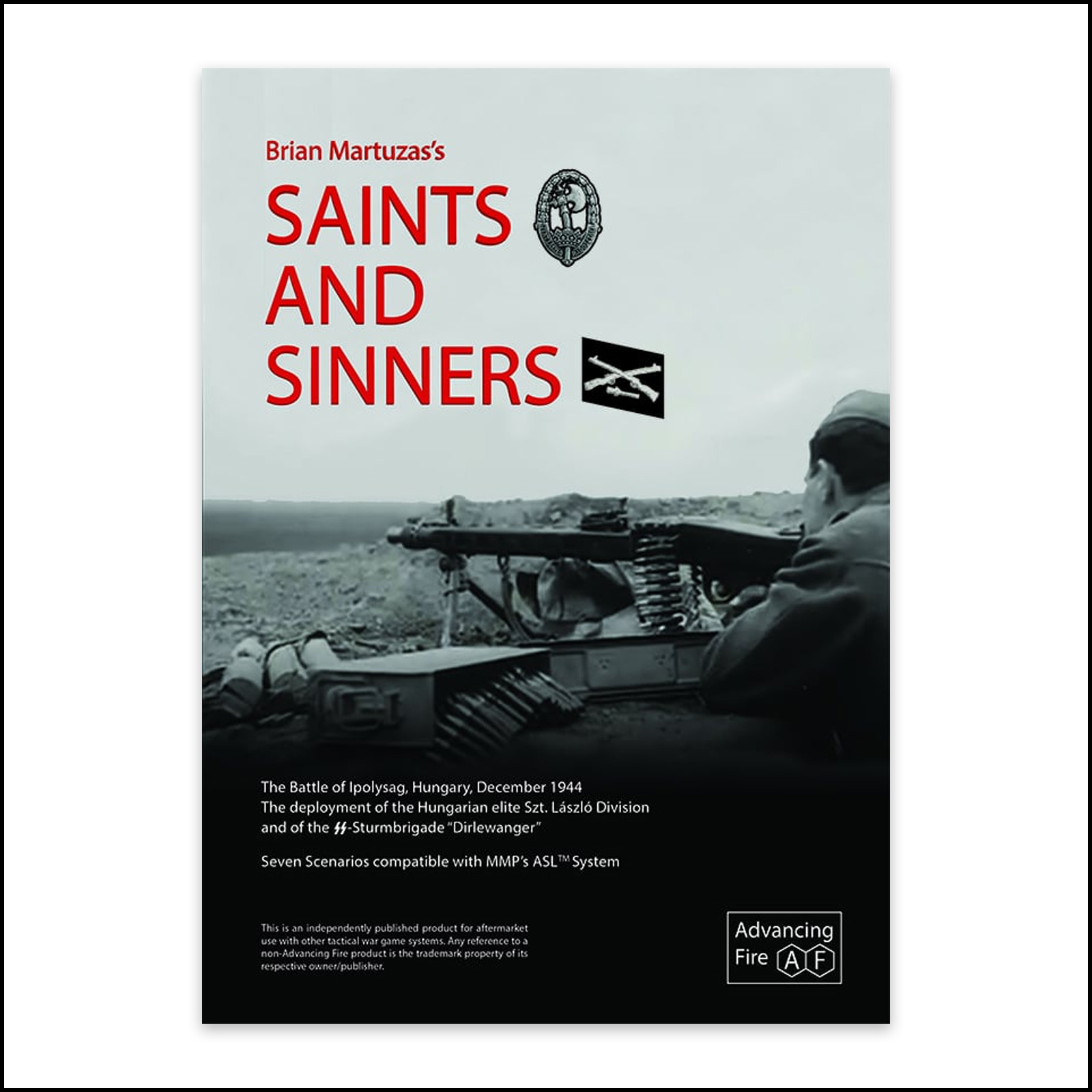
This project was spawned due to reading two very good books: Days of Battle by Norbert Számvéber and The Defeat of the Damned by Douglas Nash. The former I first read back in 2006 and have reread it twice more. I have found limited good sources in English on the Hungarians and battles in Hungary from 1944-1945 other than those dealing with Budapest. Days of Battle has enough material to help design scenarios but still lack that extra detail that scenario designers crave.
What stood out to me were the reports of the valor displayed by the Hungarian St László Parachute Division. Well trained, well led, highly motivated this unit became a “fire brigade” whose bravery ultimately led to their demise through attrition. Although still revered in Hungary, little mention of this unit appears in English language publications. Saints and Sinners only covers those actions that took place just a few weeks before the fight for Zámoly, about 70 km to the northeast. Understrength throughout their given missions, they still put up determined resistance until the end of the battles in Hungary. This is reflected in the included scenario submissions. They rarely attacked with a favorable ratio of attacker to defenders. Still, they performed very well. I await future publications that include their contributions with—hopefully—more detail.
Another motivation to get more Hungarians into ASL scenario designs was my short lived but remarkable experience with a former Hungarian Officer who served with the Hungarian 2nd Armored Division—Matyan Eszes. My sources for scenario ASL 117 originally designed in the late ’90s erroneously cited the presence of Lt Matyan Eszes in this battle. Fast forward to around 2016 and I get a message from his son—Zoltan Eszes. Zoltan plays ASL and after reading his father’s name in the scenario he contacted me to tell me that his father was still alive. I immediately thought that it would be great if I could go to Hungary to meet and interview him. To my great surprise, I found out that he was in Milwaukee, Wisconsin, where I was also living at that time. A truly remarkable coincidence. Soon thereafter I was able to meet and interview Matyan with Zoltan helping with the conversation when Matyan switched to Hungarian. Despite his failing health he still had enthusiasm for an audience with me. During those interviews he related that although he was with the 2nd Armored Division he was not involved in the battle depicted in ASL. My book sources failed me. However, he was a tank commander but only fought engagement against infantry with only one memorable encounter with a Romanian Stug—or “Stiggie” as he called them. A hit from this Stug set off the Smoke discharger in his tank. He was unable to retaliate against that Stug that soon departed the battlefield. Before he passed, because he was impressed with my passion for history, he graciously had Zoltan give me all his books and material on Hungary in WWII. A true treasure trove, although most of these are in Hungarian. May I live long enough to learn enough Hungarian to put this information to use. I still have video taken during those interviews. In an homage to Matyan, I have asked Sebi to include a Hungarian armor leader named M. Eszes and an Infantry leader named Z. Eszes. Every time I use these counters will bring back fond memories. This will encourage me to design more Hungarian scenarios in the future. Although he was not involved in any of the battles depicted in my scenarios, I have placed his counter in the OB. I just wish I had more time to spend with him. His story is truly remarkable.
Now for the latter—the Sinners. Reading about the Sonderkommando is not pleasant reading. I have several books on Dirlewanger but only Nash’s book cited above had detailed information on the battles they fought in the Ipoly area. The theme of the work caught my attention as the author questioned what in the world was a unit such as this doing on the front lines against such a formidable foe as the Red Army in 1944. The other books seem to focus on the atrocities and misconduct during anti-partisan sweeps and their infamy gained from their involvement with the Warsaw Uprising. Unfortunately for me, their combat in Slovakia and Ipoly are glossed over.
In no way do I attempt to glorify this unit. They were involved in these battles and therefore included in the scenarios. What I did glean from Nash’s work was how uneven these units behaved in battle. One entire Battalion simply defected to the Russians at the first opportunity while others fought very well. Their officers were often brutal, but some were seasoned veterans cashiered from the Wehrmacht or other SS units due to anti-Hitler sentiments or crimes committed. Many were conscripted out of penal institutions with the same options given to their Russian counterparts—redeem yourself in battle or die trying. Very few succeeded. What stands out is that these units were not suited for front line combat as they fought with captured or “booty” weapons. Their only anti-tank defense was with Czech 37 Anti tank guns. They did not have panzerfausts issued to them—as well as panzerschreks—nor were they trained how to use these weapons. There is no evidence of them having anti-tank mines as well.
As time passes I have been limiting my scenario design output. We truly have a glut of scenarios to play and even if you are now just in your 20s, you may not have enough time to play all the published scenarios in your lifetime. So, what I aim to do now is to design scenarios that are different. I try to use the new boards, units, as well as using the many overlays ASL provides. I take on more of a historical approach and try to create the “feel” of the situations portrayed. Yes, they tend to be large but that is just my preference. Here are my design thoughts in a nutshell:
AF1 ANGER NEAR CSOMÁD Crossroads, river crossings and train stations and rail hubs were magnets for both sides. The overlay is added because there WAS a RR station that had to be seized. The Germans face a strong armored force and must rely on that one Panther to stem the onslaught. The air support is key but note that gun armed Stukas are susceptible to AA fire BEFORE they conduct their point attack, unlike regular Stuka bomb attacks. The Russians need to watch the skies.
AF2 HAVOC AT HOMOK The Russians have broken through and the Germans hastily scrape together a counterattacking force that attacks from two directions. The Russians have Lend Lease support and outnumber the attackers. Late model Jagdpanzers are hard to kill from the front facing.
AF3 RUNNING AMOK AT HOMOK Again a multi-directional attack against a strong defense determined to hold on to recently won railroad station. The German 120 mortar puts in a rare appearance which is surprising considering how widespread their use was from ’44 onwards. Pop gun Valentines get into play knowing they cannot slug it out with German armor. The 57LL is deadly but getting that piece into action will be challenging.
AF4 THE SAINTS BAPTISM Primarily an infantry battle with the Hungarians forced to press into the attack their lightly armed and armored Toldi tanks. There are not that many scenarios that have that deadly flamethrowing halftrack. When to use it is key. The Toldis will not survive too long if thrown hastily into battle.
AF5 ROUND TRIP The shattered Hungarian armored units are fleeing the battlefield. However, another multi directional attack by the Hungarian paratroopers succeeds in halting the rout and now launch their attack which has the Ipoly river in its path. Seizing the bridge and securing the heights is the challenge. The Russians need to be wary of being encircled.
AF6 NORTHSIDE SOUTHSIDE A Russian bridgehead is formed with a tank unit across the Ipoly river. A night attack by the Germans succeeds in blowing up the bridges, thus isolating the Russian units that must fight to the death. There is restricted space because there WAS restricted terrain as they are in a mountainous area. Panzerschrek teams and hard to kill Hetzers are key to this one. There are many vehicles in a confined area making both attack and defend strategies difficult.
AF7 ROAD RAGE Ever since playing SL Scenario 20 Breakout From Borisov I have always sought out mobile meeting engagements. Once again the attacker is outnumbered. Both sides have many different units to throw at each other. The Russian player will notice how hard it is to kill the uparmored Jagdpanzers even with their 85L T-34s.
As I age, I feel as if I am playing my favorite arcade game but am running low on quarters. I have been designing scenarios since the late ’70s and wonder how much longer the good Lord shall allow me the time to play ASL as well as design future scenarios. It is my hope that you find these scenarios challenging, different, and ultimately, fun.
So much ASL, so little time.
Brian Martuzas
COMPLEXITY
VERY HIGH
HIGH
MEDIUM
LOW
SOLITAIRE SUITABILITY
Time Scale: ≈ 6 minutes per Game Turn
Map Scale: 40 meters per hex
Players: 2 (also suitable for solitaire and team play), 3 Player Version for one scenario
Unit Scale: 5 to 10 men with individual leaders, vehicles, guns, aircrafts
Playing Time: 3 hours and up, depending on scenario played
Contents: 7 action packed scenarios
This is not a complete game. Ownership of the following MMP/Hasbro/BFP products are required to play all of the included scenarios: Beyond Valor®, Armies of Oblivion®, boards 11, 19, 33, 40, 66, 69, 84, 86, 97, 99, 5a, 6a, 21a, 23a, g, h, x, BFP HW1a
Brian Martuzas’s
SAINTS
AND
SINNERS
© 2026 Advancing Fire
SAS SPECIAL SCENARIO RULES
SAS1 SAINT LÁSZLÓ: MMC of Hungarian formations classified as Saint László (or Szent László) are elite and have underscored Morale Factor (A19.13). Saint László squads have broken Morale Level of 8 and Saint László HS have broken Morale Level of 7. Saint László units have an ELR of 5 and use captured SW without penalty.
SAS2 DIRLEWANGER: German units of formations classified as Dirlewanger are not SS, nor are they elite for Heat of Battle (A15.) and for Depletion Number (C8.2) and have no PF capability. Dirlewanger units apply a further +1 drm to an ATMM Check (C13.7) [EXC: SMC]. Dirlewanger MMC have underscored Morale Level. Dirlewanger squads have Assault Fire (A7.36) capability.
SAS3 44.M PÁNCÉLRÉM: a portable rocket-powered anti-tank weapon developed by Hungary during World War II. The weapon combined the 60 mm caliber of the American M1 Bazooka with the grips and protective shield inspired by the German Panzerschreck. All BAZ44 rules apply to the 44M except that its X# is 10 and it is available from May 1944 on.
X10
1PP
16TK
44M
8-4
| Range | TH# |
|---|---|
| 0 | 11 |
| 1 | 9 |
| 2 | 8 |
| 3 | 7 |
| 4 | 4 |
SAINTS AND SINNERS
HISTORICAL RESEARCH AND DESIGN: Brian Martuzas (with a little help from Seb Caltabiano)
GRAPHICS DESIGN: Sebastiano Caltabiano
PLAYTESTERS: Roberto Alesse, Mike Di Fabio, Maurizio Grassi, James Husband, Ben Jones, Saverio Lodigiani, Fabio Mazzucchelli, Fred McDowell, Kevin Meyer, John Otrompke, David Perham, Steve Thorne, Steve Townend, Jim Traver, Bruno Vazquez, Mason Dixon ASL Club
Advancing
Fire
A F
Reviews
There are no reviews yet.